Two weeks after Nordic Game 2007 conference, I am already looking forward the next year. What a nice event it was indeed! Meanwhile being too busy to publish my own entry, I have been enjoying the notes and pictures of other NG07 participants, such as Sonja Kangas, Tanja Sihvonen and Jason Della Rocca. Finally, here comes my personal overview for the conference:
The mixture of industry and scholars was rather refreshing to me since I have not attended this kind of events before. Presentations gave nice overview on perspectives that people can have to games. Paulina Bozek introduced the MyEverything -thinking behind the new Singstar game for Playstation 3, Papermint guys were citing Nietzsche (or other famous philosopher) and wearing wigs, T.L. Taylor talked convincingly about modding using example of World of Warcraft like many others and Jesper Juul recommended punishments for casual gamers. Alessandro Canossa was concerned about the still on-going “mastrubative nature” of game design while presenting linguistic approach to creating different player experiences and despite the great videos in his presentation, the Eve online dude lost my attention by noting that “girls don’t like spaceships”, since I realized that I don’t and continued texting with my phone. Even though the fabulous collection of these presentations already gave me a lot, the two Japanese ones remained my definite favourites.
Tsutomu Kouno is known from his PS2 title ICO and PSP title LocoRoco. He gave an interesting overview of the design process of this “happy game” that he described being “something interesting for women and children”. The presentation was held in English and I must say that it was a brave and admirable thing to do even though he consistently was seeking words for his thoughts without any given success (it is not easy to be Japanese). The interesting part in his presentation was that he made the entire concept work for Locoroco in transitional spaces, such as in the train with his PDA since there were no time or permission to use time from the ongoing project. Concept drawings were rather simple and motivating to see and even one of the earliest demo already looked like the finished game. Unfortunately even the greatest ideas are hard to push thru, LocoRoco being no exception. In the interview of GamesIndustry.biz from Nordic Game he is actually phrasing this despair followingly: “I have many ideas, but I can’t make them all because I am only one person.” How is this possible? Please hire more dudes to help this lonely guy to produce us more LocoRoco (or RaparperiKukkakaali, as Suvi Latva from Elvi would propose)!
The most “entertaining” performance was held by the famous Masaya Matsuura, the maker of Parappa the Rapper (1996) (that evidently emptied audience from the other tracks as my colleague Aki Järvinen from Veikkaus, the Finnish National Lottery got to find out). First part of Matsuura’s performance was hmm… rather interesting, and I have to say that even though nothing really clung to my mind (other than “games… are… somethingsomething.. human soul”) the presentation was enjoyable. This was largely due to the fact that after the talk we saw him singing with Aibo, the robot dog that participated rather successfully: only half way thru I realized that he was actually “singing on the go” and not pre-programmed.
Admittedly, the conference provided lots to take back to Finland. Additionally to refreshing presentations I got to talk with many interesting people and realized that even though I play a lot, I don’t play enough. Still, I wouldn’t play Eve Online.
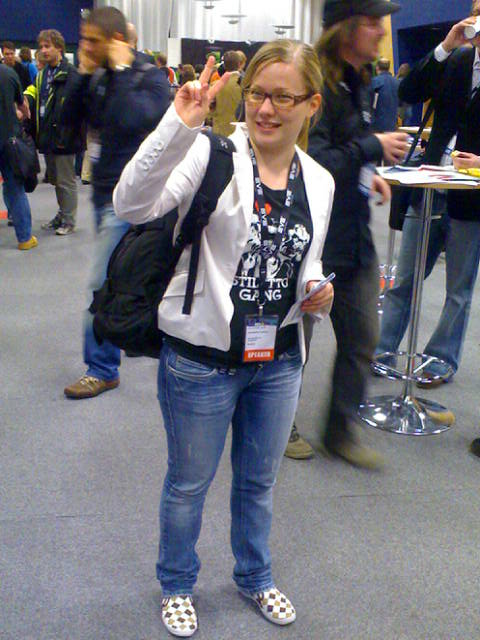
Here is a pic of me posing like a Japanese tourist at the NG07:


 AaKoo's Game Lab